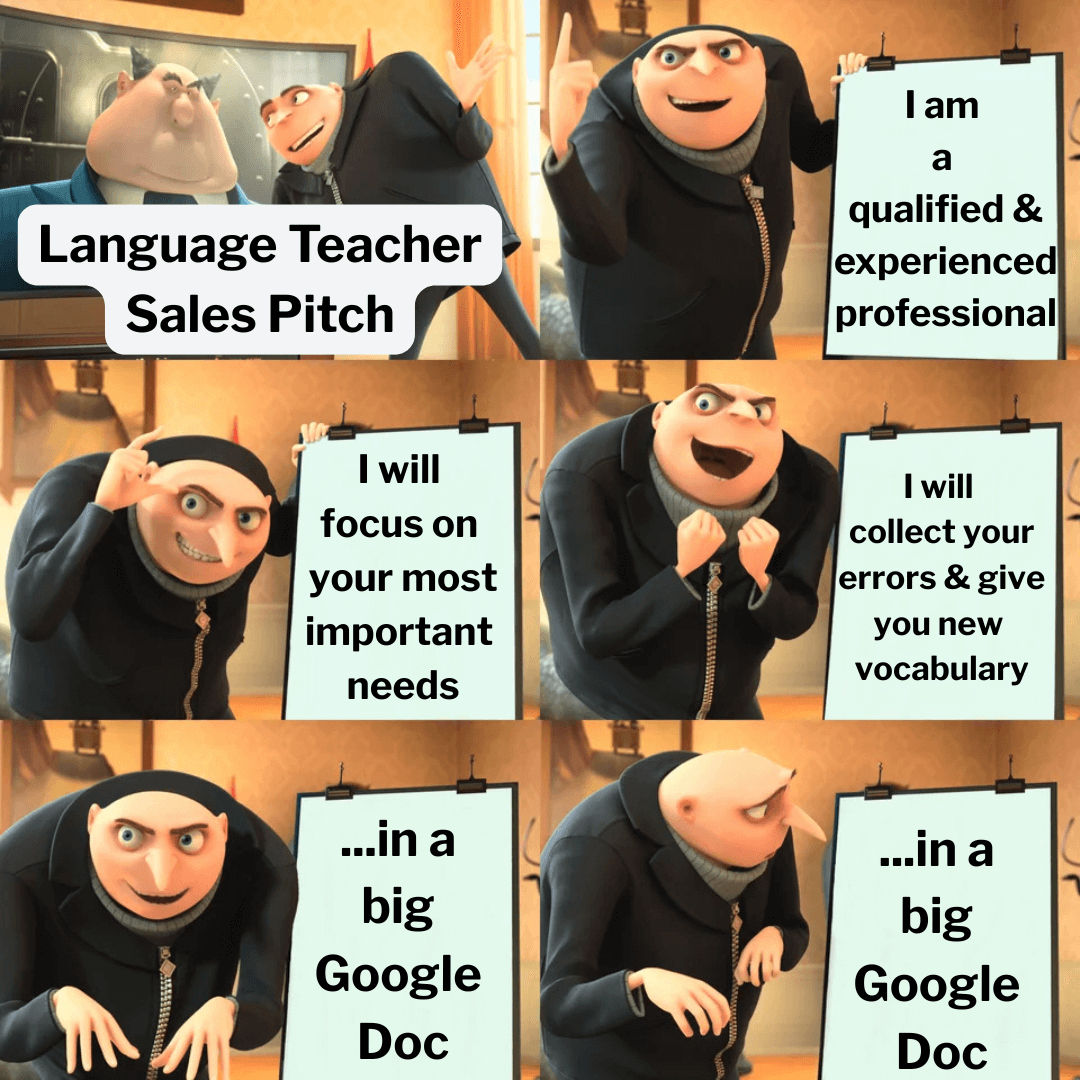
"I want to use new words!"
A lot of students ask me......
"How can I use more varied vocab in my speaking?"
"I want to use new, better, more advanced words when I speak, how?"
"What can I do to improve my basic vocabulary?"
PART 1: The Basic Solution

The solution is very simple. Get a piece of paper with like a 3x3 grid. And keep that piece of paper on your desk while you speak.
PART 2: Alternative Solution
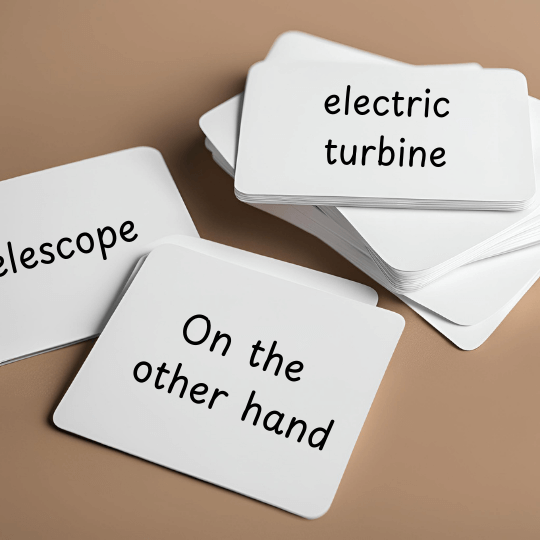
Why not write out cards?
Extra advantages - you can use them for study too. You can order them and eliminate them as you practice and improve
PART 3: Top Tips to improve your Class Prompts
1) Focus on one (maybe two) option(s) at a time - too much choice can make it too difficult to focus. With a sheet you could circle the phrase you want to use next.
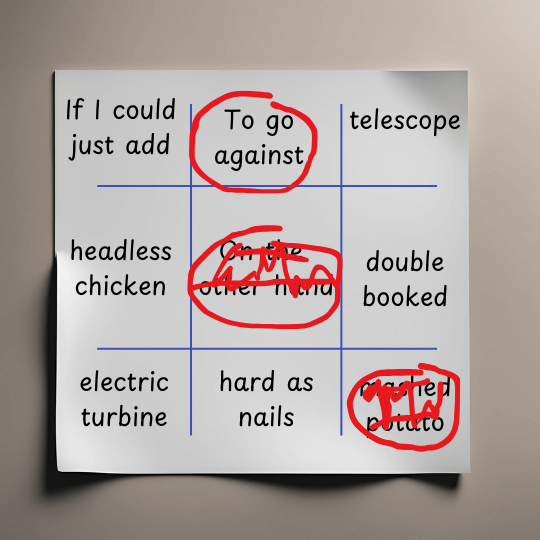
2) With cards you can keep only one phrase visible.
3) Don't aim to practice too many words and phrases! Perhaps around 10-15 words or 5-10 phrases should be ok - find out what works best for you!
4) Send me a list of the words you are aiming to practice in class - perhaps I can prompt you or I can try to use the vocabulary too!
PART 4: The BIG Problem

It is extremely difficult to tell your story, explain your ideas or express yourself (the CONTENT of your speech) while also aiming to artificially use a word, phrase or grammar structure (the FORM of your speech).
And this is true even in your native language!
Test yourself in your native language. Speak out loud and describe your family while using the Past Continuous in your mother tongue. Now use any conditional sentence (If I.....) while describing your day today. Maybe you managed a few sentences, but it was also probably not very fluent.
So basically you can either think about CONTENT or you can think about FORM.
So prompting yourself with vocabulary to use CAN BE VERY DIFFICULT and SURPRISINGLY FRUSTRATING!
So what can we do?
PART 5: Solutions to The BIG Problem
5.1 AIM TO *MINIMISE* THINKING ABOUT FORM
- Aim to be as familiar as possible with all vocabulary on your prompt sheet - the more you are familiar the easier will be to insert it
- Add some extra words around the phrases to help you insert the words into the conversation - for example, "sly as a fox" to "he is AS SLY AS A FOX", "to lead" to "this LEADS TO that" change "to expect" to "to expect something" (no preposition), or "to expect something to happen" etc.
- Or, you can go one step further and have a complete sentence (although this is a less flexible prompt) for example "I was expecting something very different to happen".
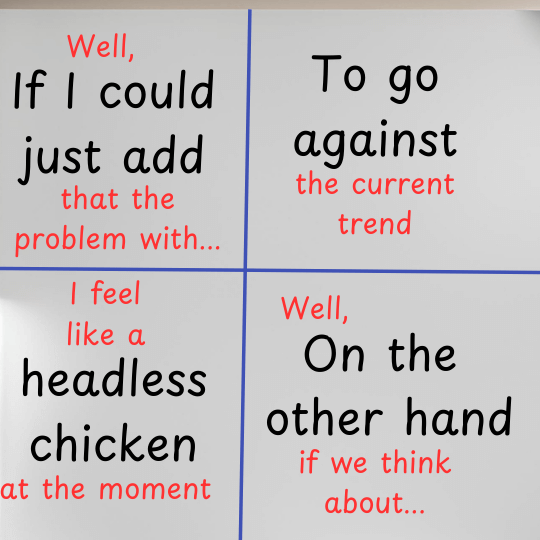
5.2 AIM TO *MINIMISE* THINKING ABOUT CONTENT
- The most basic exercise would be to give an example of that sentence with no context or reference to the previous sentence. But this is not fun and doesn't *feel* like a conversation
- The idea here is to have a silly discussion with your teacher that follows the logic of an argument but you are not interested in your *ideas* within the argument.
- So a Silly Debate about whether "APPLES ARE BETTER THAN BANANAS"!
Here we want to ignore the quality or even logic of the conversation.
SILLY DEBATES! A better alternative!
PART 6. Where can I find these words and phrases?
There are maybe THREE BIG AREAS to consider as sources...
- 1) Your personal needs & interests
- 2) Your personal expression in your native language
- 3) The most frequent words & phrases in the target language
Your personal needs & interests
- What topics do you like to talk about?
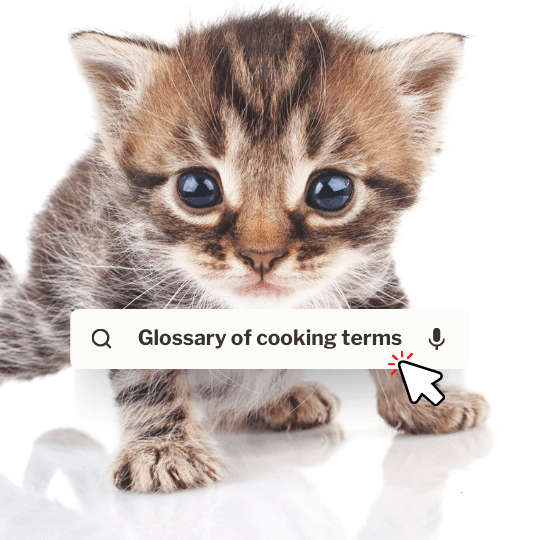
- Have you looked for any GLOSSARIES online? Eg "glossary of football terms" ...or marketing, or cooking etc. Glossaries are much more user friendly than dictionaries!
- Write down any words that do not come to you when you need them!
Your personal expression in your native language
- Very similar to the first category but here we are looking at more general language (not technical/specific vocabulary)
- Write down your most common idioms in your native language - idioms are mini philosophies and capture big ideas quickly - can you say these in English?
- Take some of your old messages and emails and ask an A.I. service (eg ChatGPT) to find your most common structures, can you say these phrases in English?
- Think about your most common stories, write them in your native language with as much expression as you can - imagine you are telling a friend the story - then translate the story with A.I. etc - are there any new phrases for you to practice using?
The most frequent words & phrases in the target language
- Here we are considering what are the most common, most used, most natural language that speakers of the language use frequently.
- The following ideas have examples and links in PART TEN: Resources for Students
- There are many lists of words and phrase that have been ordered by frequency by acadmics and researchers (see links below) these are a good way find very frequent vocablary.
- But as well as formally researched language, there can be many informal sources that offer very natural, very frequent and very useful language!
- And listed below in Resources for Students I have listed some blog posts with useful language and I have listed some You Tube etc videos
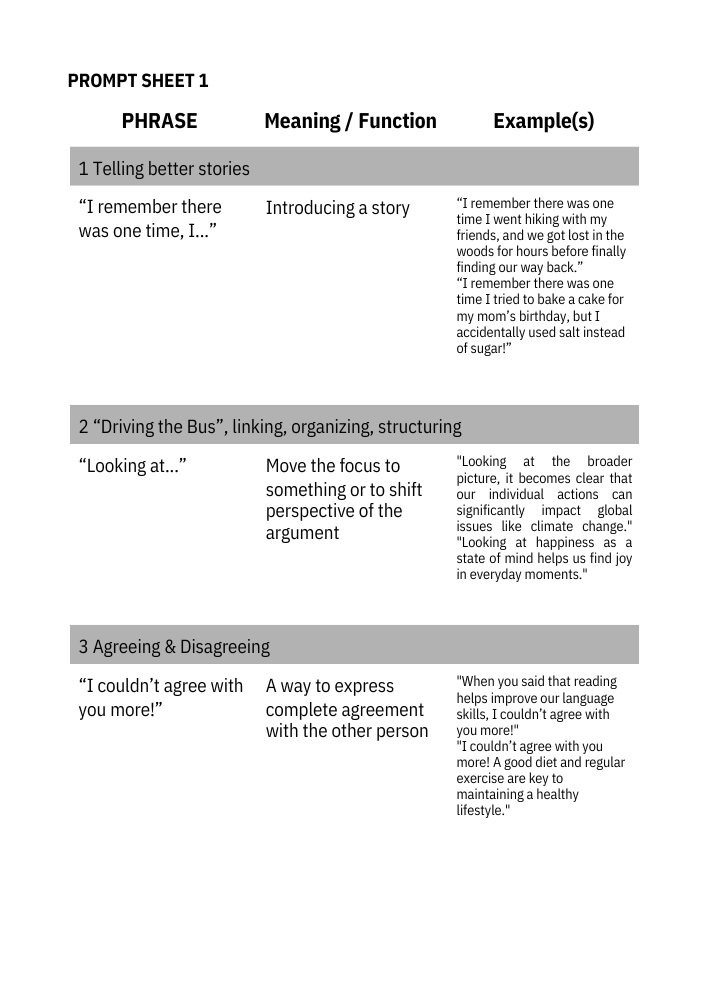
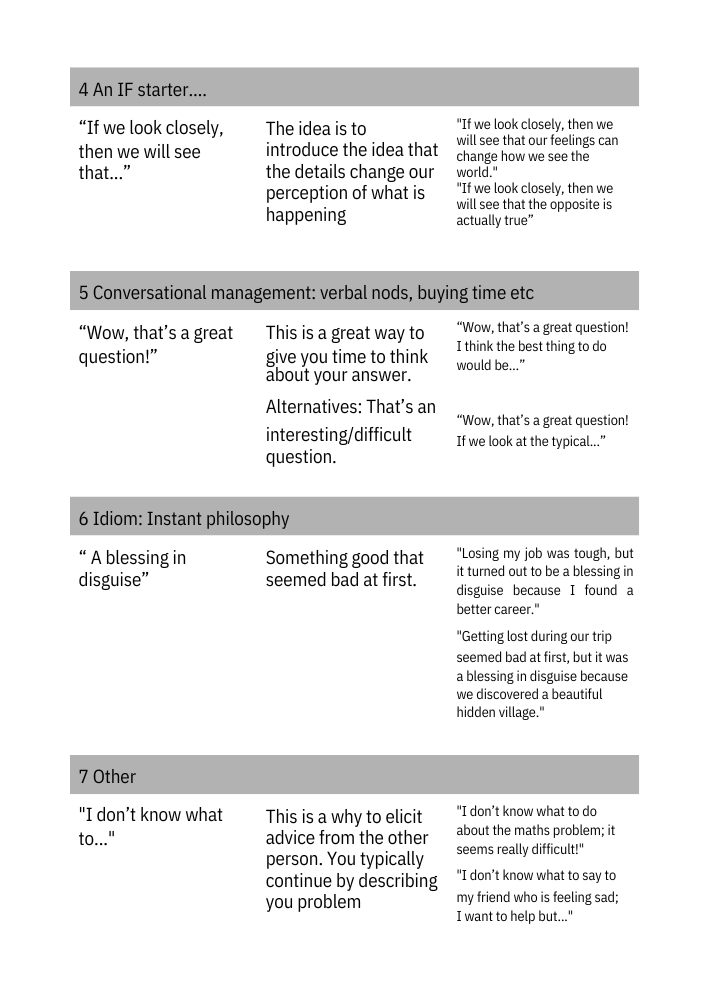
- And of course your teacher can provide you with a Prompt Sheet....
- My example of some prompt ideas that I send to students!
PART 7. How can I manage this vocabulary?
KEEP A LIST!
(or a SET OF CARDS!)
- 1) Update the list/cards with new words & phrases
- 2) Remove phrases that you think you have mastered
- 3) Consider re-ordering the list or card set so you practice new phrases and old ones come back in the future
PART 8. How can I practice this vocabulary to become more and more familiar with it?
Places to practice your PROMPT LIST
-
Ask YOUGLISH
- Listen to the phrase said in hundreds of YouTube videos!
- https://www.youglish.com
-
Ask CONTEXTO REVERSO
- See the phrase in various sentences with a translation in your native language
- https://context.reverso.net/traduzione/
-
Use A.I. simple create and correct
- I use ChatGPT but should work in any AI service
- Simply write sentences that use your word or phrase and ask the AI to check your English
-
Add the phrase to your flashcard system
- Ways to have it as a study card:
- As a translation
- As a gap fil (1st letter)
- Reorder the words
- An alternative way to say X
-
Use vocab section of fluency lesson
- Remind your teacher to add the words in your list to the VOCAB section of Fluency Lesson
- Now if you write a sentence it will be automatically checked by AI, and at a later time your teacher can check your usage too
PART 9. SUMMARY: What are the responsibilities of the TEACHER and of the STUDENT?
Teacher Responsibilities
- Offer new prompt ideas
- Offer chance in lesson to preview, practice and and use prompt list in class
- Offer ideas on how to practice these words outside of class
Student Responsibilities
- Review prompt ideas pre lesson
- keep a prompt list
- do activities to increase your baseline familiarity outside of class
- organize prompts for use in fluency activity in class (as well as practice activities at start of lesson)
PART 10. Resources for Students
Examples of Teacher Prompt Ideas
-
Prompt Ideas 1
Prompt Ideas 1 (PDF) [CLICK = OPEN PDF IN NEW TAB]
Prompt Ideas 1 (Word DOC - editable) [CLICK = THIS WILL DOWNLOAD AUTOMATICALLY]
Prompt Sheet 2
Prompt Ideas 2 (PDF) [CLICK = OPEN PDF IN NEW TAB]
Prompt Ideas 2 (Word DOC - editable) [CLICK = THIS WILL DOWNLOAD AUTOMATICALLY]
Examples of Glossaries
- It is very easy to find glossaries about any topic, just search on the internet!
- For example there are many for big or business areas, here are two for MARKETING - but there are many more find one you like!!
-
TWO EXAMPLES OF MARKETING GLOSSARIES:
https://www.demandcurve.com/blog/the-complete-glossary-of-marketing-terms
https://blog.hubspot.com/marketing/inbound-marketing-glossary-list
- But what about....
-
Example of a Cooking Glossary
https://www.goodhousekeeping.com/food-recipes/cooking/tips/a16958/dictionary-cooking-terms/
-
Example of a Programming Glossary
https://codeinstitute.net/global/blog/programming-and-coding-terms/
-
Example of a Football Glossary
https://en.wikipedia.org/wiki/Glossary_of_association_football_terms
-
Example of a Travelling Glossary
https://totochie.com/travel-glossary/
-
Example of a History Glossary
https://en.wikipedia.org/wiki/Glossary_of_history
Tell Better Stories
- How to tell a better story
- Two videos that give some ideas about how to improve and structure your story telling techniques
- Lots of basic phrases:
-
English Vocabulary used in storytelling:
https://www.youtube.com/watch?v=guLmchF-BN0
-
Basic storytelling prosody:
Speaking Practice and Tell a great story:
https://www.youtube.com/watch?v=IqJlqzEfyKo
CONNECTIVE LANGUAGE
- First resource, have a look at these videos and blog posts and think about what style of linking language appeals to you most:
Examples of Video Resources
-
This is a nice introduction to the area and with lots of the most common discourse markers!
https://www.youtube.com/watch?v=wOx50owZLyA
(Learn English with TV) -
Another good introduction with examples of how to use some of the simplest discourse markers in very useful ways!
https://www.youtube.com/watch?v=cc5PVfbP4is
-
In spite of / Despite / Even though / Although = quite clear structure shown and examples – can be good to highlight how these words need specific grammar (+ noun / gerund)
https://www.youtube.com/watch?v=ZYd3whIRpik -
More general spoken discourse markers – but here note how they link sentences that are quite standard (sentence + discourse marker + sentence)
https://www.youtube.com/watch?v=BECe_ok1RI8
-
Here are some more colloquial CONVERSATIONAL style phrases – what words & phrases do the students want to learn? (IELTS LEVEL) Focused on natural spoken linking words
https://www.youtube.com/watch?v=a-RIoxqZ-Gc
Examples of Blog Resources
-
Have a look at this article that I wrote for the IELTS exam, where the types and functions of connecting language is analysed.
https://www.englishadam.com/Using-Connectors-IELTS-Task-1
-
Here is another article I wrote which is about how to buy time when you speak.
“9 Ways and 42 Phrases and Words That Give You Time To Think”
https://www.englishadam.com/Phrases_Words_Give_Time_To_Think
Frequency Lists from Academic Research
- Linguist Norbert Schmitt lists, explains and gives examples of the most common phrasal verbs in English.
-
Do you know them all?
https://www.norbertschmitt.co.uk/_files/ugd/5f2482_fb2f15be0d104d08802d9ffd722e5782.pdf
- Linguist Norbert Schmitt lists the most common phrases/chunks (spoken, written, academic) in English.
-
Which ones could be good for you to use?
https://www.norbertschmitt.co.uk/_files/ugd/5f2482_63c555de9e3f4c09af4170ba051b3bbe.doc?dn=AL%20Martinez%20and%20Schmitt%20-%20PHRASE%20List.doc
(This link will create a downloadable word doc – not a web page)